new york · usa · 2022
vroom
ux case study

Role
UX Research Analyst
Team
3 researchers
Methods
Survey + Formative / Concept Usability Testing
Study Type
Generative, Exploratory Quantitative UX Study
Project Overview
A lean, exploratory UX research initiative that helped to preliminarily validate an envisioned consumer experience space and strategic creative direction: online used car shopping as reimagined through the lens of a dating app.
We helped the automotive e-commerce platform Vroom conduct this research before potential investment into further building. By examining user behaviors and emotional drivers common to "swipe culture," the study surfaced trust dynamics, identity alignment needs, and design gaps in current car-buying platforms.
Motivation
Our client’s research showed that today’s digital car shoppers are open to exploring many options,not often fixated on a single make or model. Traditional car-buying websites, built around an outdated dealership mindset, assume customers already know what they want. This mismatch creates both opportunity and risk: openness drives discovery, but the current structure overwhelms users with too many choices and no clear guidance.
The client aimed to usher in a new era of online car shopping for younger, digital-first buyers. These users often faced decision fatigue, confusion, and frustration on traditional sites, leading to fewer conversions and lower sales. Ideating an app offered a chance to reimagine the experience with a focused, intuitive journey that fits modern digital behaviors and positions the brand as an innovative, attention-grabbing industry leader.
Key Research Questions
01
In-app shopping decisions
How do open-minded, digital shoppers make choices and purchasing decisions when their shopping experience happens entirely in-app? Are there new considerations and drivers that emerge when users shop for something exclusively in an app?
SURVEY
01
Barriers to Online Car Buying
What barriers or hesitations prevent users from completing the car-buying process exclusively online or in app formats, compared to traditional dealership or other in-person buying experiences?
METHODS
01
Application of Familiar UI Patterns
How might design strategies and familiar UI patterns from dating and social apps be applied to car-buying platforms to guide open-minded shoppers, reduce decision fatigue, and simplify the process of exploring and comparing options?
FORMATIVE TESTING + SURVEY
Methods
The data collection involved two methods: a comprehensive Survey and targeted Formative Testing.
Survey
n=469
DEMOGRAPHIC
U.S. adults (18-44) likely to buy a car in 12-36 months
QUESTIONS
Mixed: Likert scale, multiple choice, and open-ended, covering behavioral, emotional, comparative, and attitudinal questions.
RATIONALE
Provided scalable insights into shopping patterns, expectations, and hesitations among younger, digital-first audiences. We used comparative framing (dating apps, car shopping, home buying) to reveal parallels in trust and decision-making.
ANALYSIS
Descriptive stats, cross-tabulation, segmentation (gender, age), and coded qualitative responses.
.png)
Formative Testing
n=8
DEMOGRAPHIC
U.S. adults (23-41), recruited through personal networks, word-of-mouth, and snowballing.
METRICS
Error rate, single ease questions, think-aloud data, verbal feedback, and emotional mapping.
RATIONALE
Revealed how users interacted with early design concepts, providing feedback on frustrations, expectations, and decision fatigue using a "swipe-based" tool.
ANALYSIS
Affinity mapping gathered clusters of insights, providing directional intel on current mental models.

In-App Shopping Decisions
WHAT WE LEARNED
While motivations still reflect traditional in-person buyers (led by price, lifestyle fit, and use cases), users are actually more likely to be more strict and uncompromising in enforcing these guidelines for themselves when shopping exclusively online. The strongest consideration was lifestyle-based evaluation, with 75% reporting it as an extremely or very important factor.
RECOMMENDED DESIGN RESPONSE
-
Design multiple-selection curated entry pathways into car browsing (e.g., “For Families,” “For Adventurers,”).
-
Explore the potential for profile-style vehicle presentations, emphasizing lifestyle tags alongside specs.
Research Question 2: Barriers to Online Car Buying
WHAT WE LEARNED
Users were highly uncomfortable with purchasing a car exclusively online, mirroring their hesitation with buying a home. Only 16% of respondents felt comfortable buying a car online without having seen it in person.
-
Top Hesitations: Lack of test drives (61%) and concerns about misleading photos (60%).
-
Trust emerged as the main barrier to converting online intent into action. A promising 54% would still consider buying online despite hesitations, showing strong openness to the idea.
RECOMMENDED DESIGN RESPONSE
-
Proposed verified vehicle profiles, standardized photo prompts, and multimedia features like 360° tours and virtual test drives.
-
Borrowed design cues from dating/social apps (e.g., verification badges) to signal authenticity and build confidence.
Research Question 3: Applying Dating/Social UI Patterns
FINDINGS
Users had three key requests during testing:
-
Pictures: Disliked inconsistent photography, wanting cohesive and repeated angles.
-
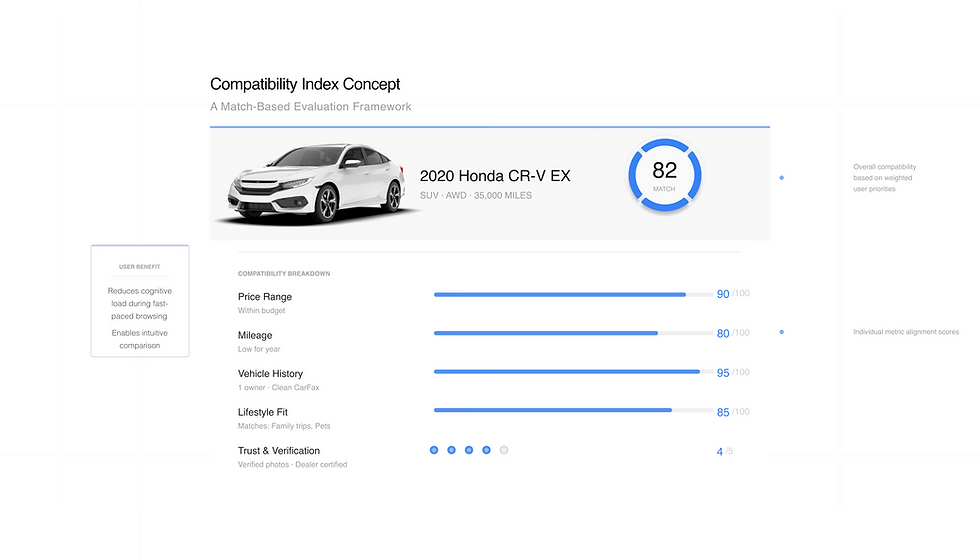
Metrics: Wanted key info (CarFax, mileage, price) up front, at a glance.
-
Filtering: Wanted to filter before swiping (color, size, features).
RECOMMENDED DESIGN RESPONSE
-
Designed a compatibility index, a composite matrix of the user’s most important considerations built into a quick indicator showing scores or levels of which each car aligns with each of their top priorities.
-
A standardized, multi-angle photography guidelines and verification workflows.
-
Introduced pre-swipe filtering tools to reduce cognitive load.
Outcomes & Conclusion
Delivered a Feature Roadmap Grounded in User Evidence. The client now has data-driven justification to prioritize features like:
-
Verified vehicle profiles (to combat misleading photos).
-
Standardized, multi-angle photography and 360° tours (to build trust).
-
Lifestyle-based browsing and filtering (to align with how users actually explore).
-
Compatibility index (to reduce overwhelm and simplify comparisons).
-
Positioned the Client to Innovate with Familiar Interaction Models. By integrating swipe-style discovery, saving/shortlisting, and algorithmic suggestions, the brand can differentiate from competitors.
-
The study delivered a baseline for A/B testing and further validation by investigating the space for exclusively online car-buying.
Conclusion
We validated the space for completely online car-buying, including swipe-app style interfaces, but only if the tool is conducive and makes it easier for users to do rigorous research. Our research alerted the client to the deep discomfort many users still feel about purchasing a car entirely online. We equipped the client with concrete ways to design solutions to alleviate hesitation before launch, ensuring they are prepared to neutralize these barriers.
CLOSING NOTE
This case study presents the polished outcomes of a pilot research initiative, but the process included iterations and behind-the-scenes decisions that can’t all be captured here. If you’d like to dive deeper into how we designed the survey and usability tests, the challenges we faced, and the ideas I’d explore in future iterations, I’d be happy to walk you through the full story in an interview or live presentation.
Contact Information:
-
Email: isleyjbolar@gmail.com
-
LinkedIn: https://www.linkedin.com/in/isleybolar/